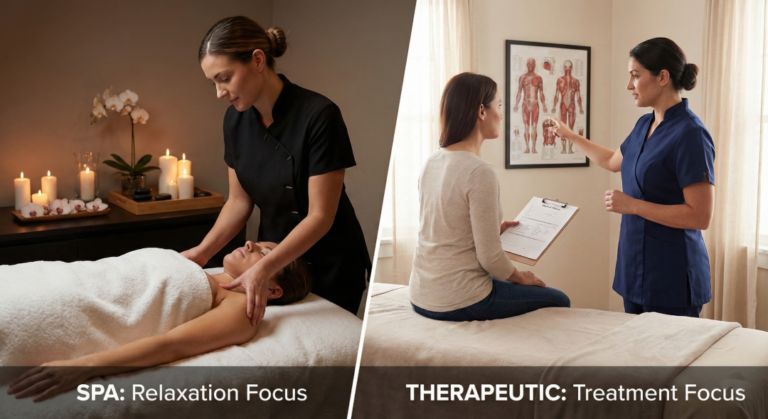
Confused between a spa massage and therapeutic treatment? Learn the difference between a qualified massage therapisConfused between a spa massage and therapeutic treatment? Learn the difference between a spa therapist and a qualified Therapeutic Massage Therapist in South Africa, and how to become one.

We have all been there. You wake up with a stiff neck or a nagging lower back ache. Your first thought is, “I need a massage.”

So, you book an appointment at a lovely local spa. The room smells like lavender, the music is soothing, and for 60 minutes, you feel relaxed. But the next morning, that nagging back ache is back—sometimes even worse than before.

Why didn’t it work?

The answer often lies in the difference between a Spa Massage and Therapeutic Massage. While they might look similar from the outside (a massage table, oil, and a therapist), the goal, training, and outcome are entirely different.

Here is why choosing a qualified, MTASA-registered therapist matters when you are dealing with pain.

The Big Misconception: Pressure vs. Purpose

A common myth in South Africa is that “Therapeutic Massage” means a soft, gentle rub, while “Deep Tissue” is what you need to fix a problem.

This is incorrect.

Therapeutic Massage is not defined by pressure; it is defined by outcome. It is a clinical discipline. A Therapeutic Massage Therapist might use very light pressure (like Manual Lymph Drainage) or very deep pressure, depending entirely on what your body needs to heal.

If you ask for “deep tissue” at a spa, you will likely get a therapist pressing hard on your muscles. If you see a Therapeutic Therapist, they will assess why the muscle is tight before deciding how to treat it.

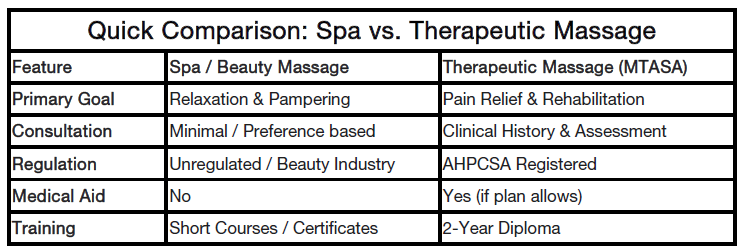
A tabled comparison of spa vs therapeutic massage

The Scope of Practice: What’s the Difference?

To understand who you should book with, you need to look at the goal of the session.

1. The Spa Therapist
  • The Goal: Relaxation, stress reduction, and general pampering.

  • The Focus: The “experience.” The priority is making you feel comfortable, reducing mental stress, and providing a luxurious environment.

  • Best For: When you want to treat yourself, unwind after a long week, or enjoy a gift voucher.

2. The MTASA Member (Therapeutic Massage Therapist)
  • The Goal: Treatment, rehabilitation, and functional improvement.

  • The Focus: The “outcome.” The priority is identifying the root cause of your pain (e.g., posture, injury, pathology) and treating it.

  • Best For: Chronic pain, sports injuries, post-operative recovery, headaches, and musculoskeletal conditions.
A warm and inviting home-based therapeutic massage studio in South Africa. The room features a massage table, soft lighting, and essential oils, but is distinguished by framed AHPCSA diplomas, a skeletal anatomy chart, and patient intake forms on the desk.
A Therapeutic Massage practice is a sanctuary grounded in science. Look for visible qualifications, anatomical charts, and intake forms—even in a home setting.

The Training Gap: Short Courses vs. 2-Year Diploma + CPDs

This is the most critical difference.

In South Africa, the barrier to entry for the beauty industry can be low. Some short courses allow someone to start massaging after just a few days of training.

In contrast, a Therapeutic Massage Therapist registered with the AHPCSA (Allied Health Professions Council of South Africa) has undergone rigorous medical-based training.

  • Duration: Typically a 2-year Diploma.

  • Curriculum: In-depth Anatomy, Physiology, Pathology (the study of disease), and Pathophysiology.

  • Clinical Hours: Required hours of supervised clinical practice.

  • Continual Professional Development: To maintain their registration, TMTs are required to complete CPD courses every couple of years, ensuring they are always up-to-date with the latest developments within their field.

This training means an MTASA member knows exactly where the nerves are, how a specific muscle interacts with a joint, and most importantly, when NOT to massage (contraindications).

3 Red Flags of Unregulated Therapy

How do you know if you are in safe hands? If you are seeking medical relief for pain, watch out for these red flags:

  1. No Intake Form: If a therapist touches you without asking for a medical history (medication, surgeries, allergies), they are putting you at risk. A Therapeutic Therapist always assesses you first.

  2. “It’s Just a Knot”: If you ask why your shoulder hurts and the answer is vague, be cautious. A qualified therapist should be able to explain the anatomy: “Your upper trapezius is tight because your pectorals are pulling your shoulders forward.”

  3. Miracle Cures: Be wary of anyone offering “curative” claims for serious diseases without evidence. Therapeutic Massage is a powerful healthcare tool, but it is evidence-based, not magic.

Trust Your Body to an Expert

There is absolutely a place for spa days—we all need to relax! But when your body is sending you pain signals, you need more than just stress-relief; you need a healthcare professional.

Don’t gamble with your health. Ensure your therapist is qualified, trained, and accountable.

Ready to find a professional? Click here to find a verified, AHPCSA-registered Therapeutic Massage Therapist local to you. 
Interested in Becoming a Therapeutic Massage Therapist?

If you are reading this and thinking, “I want to do more than just help people relax—I want to help them heal,” then Therapeutic Massage might be your calling.

However, be careful when choosing a college. Many schools offer “massage courses,” but very few offer the qualification required to become a registered healthcare professional.

The Qualification

To register with the AHPCSA and practice legally as a Therapeutic Massage Therapist, you must complete a 2-year Diploma in Therapeutic Massage.

Where to Study

Currently, the only institution in South Africa offering the full AHPCSA-accredited course to new students is Potchefstroom Academy.

  • Institution: Potchefstroom Academy

  • Course: Diploma in Therapeutic Massage

  • Duration: 2 Years (Full Time)

  • Outcome: Graduates are eligible to register with the AHPCSA and obtain a practice number.

Please note: Short courses (3-6 months) are valuable for general wellness or upskilling, but they do not qualify you to treat patients clinically or claim from medical aids.

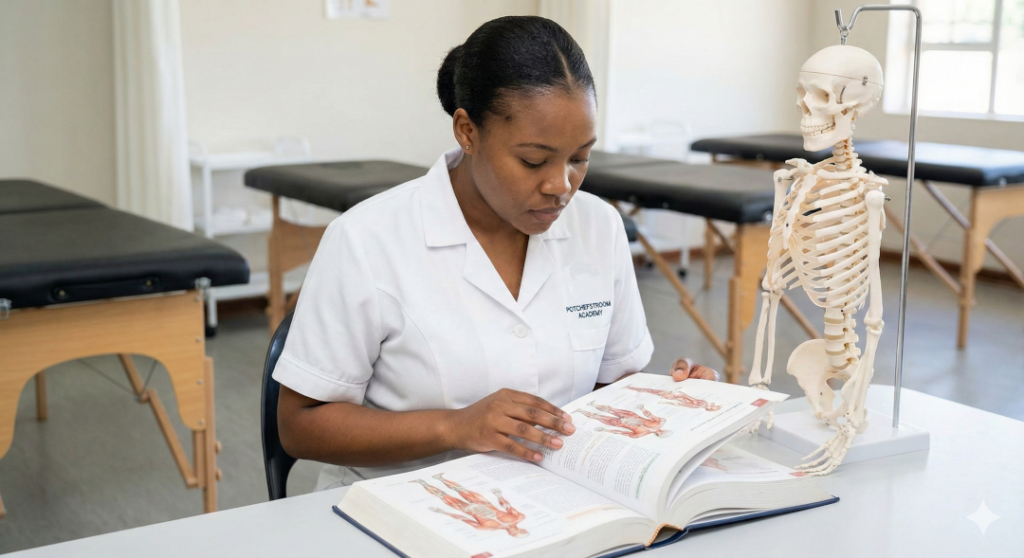
A therapeutic massage student wearing a Potchefstroom Academy tunic studying a complex human anatomy textbook and skeleton model in a clinical training facility.
Becoming a qualified Therapeutic Massage Therapist requires rigorous, AHPCSA-accredited training, such as the diploma offered at Potchefstroom Academy.