
If you are reading this, you are likely part of the “Silent Epidemic.”
Recent studies indicate that nearly 1 in 5 South African adults suffer from chronic pain. It is a condition that doesn’t just hurt physically; it exhausts you mentally, affects your work, and can lead to anxiety and depression.
For years, the standard solution has been a prescription script. But as we learn more about pain science, the medical community is shifting toward a “Multidisciplinary Approach.” This means your GP, your physiotherapist, and your Therapeutic Massage Therapist working together.
Here is why therapeutic massage is no longer just a “nice-to-have,” but a clinically recognised tool for managing long-term pain.

Chronic pain is complex. It isn’t just a physical signal; it’s a nervous system loop. Because of this, relying solely on painkillers often isn’t enough—they mask the signal but don’t always address the tissue dysfunction.
A Therapeutic Massage Therapist does not replace your doctor. Instead, we act as a partner in your recovery team. While your doctor manages the inflammation chemically and your physiotherapist prescribes exercises to strengthen the area, your massage therapist focuses on down-regulating the nervous system and maintaining soft tissue mobility so you can do those exercises.
We see three major conditions in our practices daily, where therapeutic intervention makes a measurable difference:
Fibromyalgia patients often fear massage because they have been hurt by “deep tissue” therapists in the past.
The Therapeutic Difference: We use techniques like Myofascial Release—a slow, sustained pressure that melts restriction in the connective tissue (fascia) without triggering a flare-up.
The Goal: To reduce the “noise” in your nervous system, allowing you to sleep better and move with less stiffness.
Most back pain becomes chronic because of the “Pain-Spasm Cycle.” 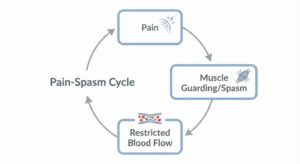
You feel pain.
Your muscles tighten (spasm) to protect the area.
The tightness restricts blood flow, causing more pain.
The cycle repeats. Therapeutic massage physically interrupts this cycle, forcing the muscle to release its guard and allowing fresh, oxygenated blood to return to the tissue.
After surgery (like a C-section or joint replacement), the body lays down collagen to heal the wound. This is good, but it often forms disorderly “clumps” (adhesions) that limit your movement.
The Treatment: Once your wound is healed, a therapist can perform specific cross-fiber friction techniques to align these collagen fibers, ensuring your scar is flexible rather than rigid.
It is not magic; it is biology. Therapeutic massage triggers two powerful chemical responses in your body:
Cortisol Reduction: Chronic pain keeps your body in “fight or flight” mode, flooding you with the stress hormone cortisol. Massage has been clinically shown to lower cortisol levels, effectively turning down the volume on your stress response.
Endorphin Release: It stimulates the release of serotonin and dopamine—your body’s natural painkillers—which can provide relief that lasts long after the session ends.
This is the most critical point. Chronic pain patients are vulnerable.
If you have arthritis, osteoporosis, or a neurological condition, an untrained therapist can cause serious harm. They might use pressure that is too deep, mobilize a joint that shouldn’t be moved, or ignore contraindications like blood thinners.
An MTASA-registered therapist is trained in Pathology. We know when not to treat. We know how to read a doctor’s referral letter. We understand the medications you are taking.
You do not have to “just live with it.” If you are managing a chronic condition, ask your doctor about integrating Therapeutic Massage into your care plan.
Ready to find a specialist? Click here to search the MTASA Member Directory to find a registered therapist who understands pain science.